Grammar in 4 Levels: -ED and -S/ES Endings
The two smallest sounds in an English sentence. Dropping them still leaves you understood — which is why the habit survives for years. In the exam room, it costs marks, and it costs them differently at every level.

There is one thing almost every Vietnamese learner skips: the ending.
-ed and -s/es are the smallest sounds in a sentence. Drop them and you are still understood — which is exactly why the habit lasts for years. In the exam room, dropping them costs marks, and it costs them differently at each level.
The rule
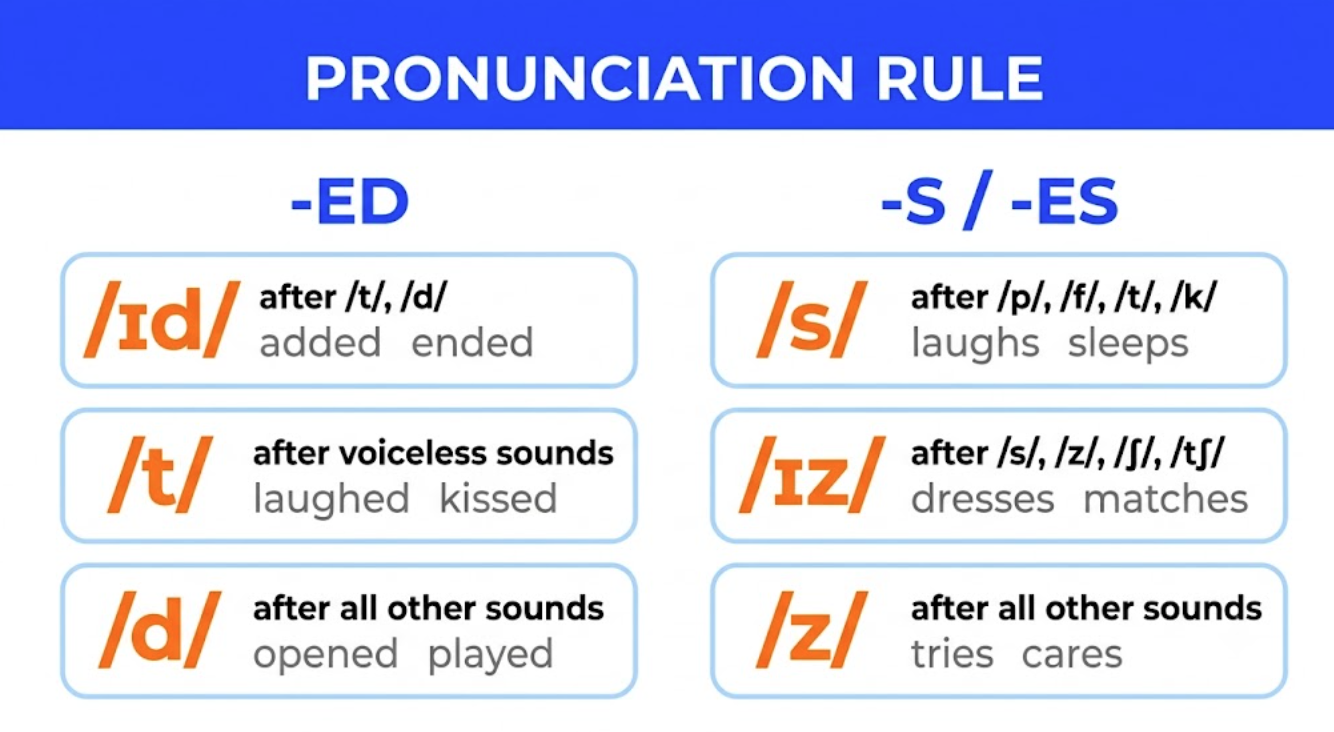
-ED has three pronunciations: /ɪd/ after /t/, /d/ — /t/ after voiceless sounds — /d/ after all other sounds.
-S/ES also has three: /s/ after /p/, /f/, /t/, /k/ — /ɪz/ after /s/, /z/, /ʃ/, /tʃ/ — /z/ after all other sounds.
Level 1 — say the ending
Most learners drop it entirely. Record ten past-tense verbs tonight and listen back.
Level 2 — hear the ending
The tape says two tickets; you hear two ticket and write the singular. Right word, lost mark.
Level 3 — know what it costs
Swallowing -ed in Speaking Part 2 does not cost you Pronunciation. It costs you Grammatical Range and Accuracy, because on the recording you used the wrong tense for two minutes.
Level 4 — linking
Above band 7, rhythm matters more than individual words, and the ending is where words join: looked at, finished it, needs a.