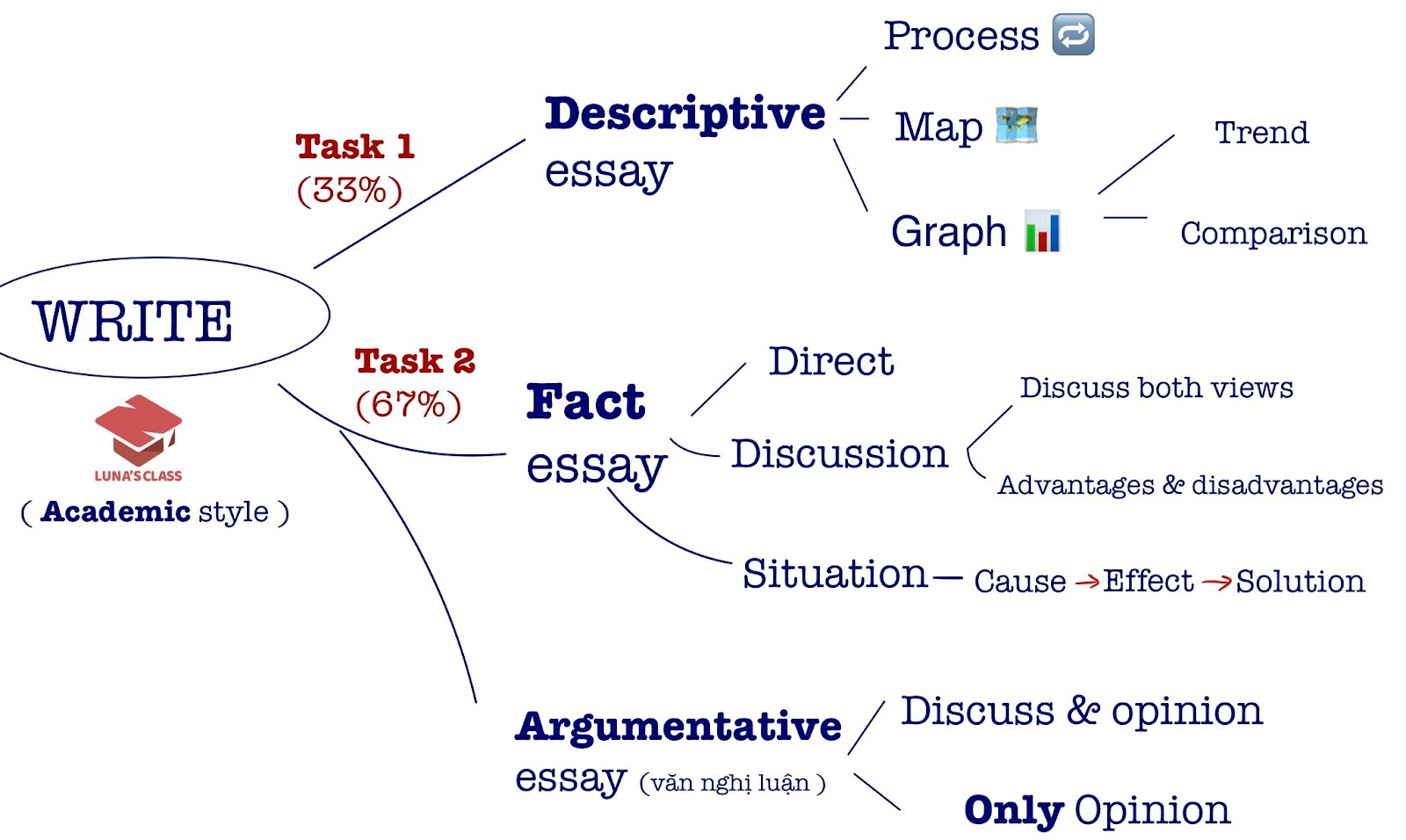
Trong 1 bài thi IELTS Writing, thí sinh sẽ phải viết 2 bài: Bài Task 1 ( dạng văn miêu tả ) chiếm 33% số điểm , trong khi bài Task 2 ( dạng văn thảo luận & nghị luận ) chiếm 67% số điểm. Do vậy, bài viết dưới đây sẽ đề cập đến 1 trong 3 dạng bài phổ biến nhất của Task 1, đó là dạng bài Graph ( miêu tả sự thay đổi của 1 xu hướng , hay hiện trạng xã hội, nhưng được thể hiện qua các visual aids khác nhau như pie, line, bar, hay table ):
Thuộc dạng bài văn MIÊU TẢ:
- Bài viết sẽ không sử dụng các từ vựng chỉ ý kiến cá nhân, hoặc từ vựng thể hiện cảm xúc hay nói một cách chung chung.
Ví dụ:
Bài Task 2: đề bài nếu nói về 1 xu hướng đang lên giới trẻ yêu thích, người học có thể sử dụng: youngsters = teenagers = the youth.
Bài Task 1: Các bạn trẻ ở lứa tuổi từ 13-17 tuổi thì sẽ phải viết cụ thể:
13-to-17 year olds = those who aged 13 to 17 = 13-to-17 year-old teenagers.
- Độ dài của các Body không nhất thiết phải bằng nhau. Vì bản chất là văn MIÊU TẢ, nên chúng ta nhìn vào hình, và CÓ SAO, DÙNG VẬY. Điều này khác, so với các dạng bài Fact của Writing - Task 2.
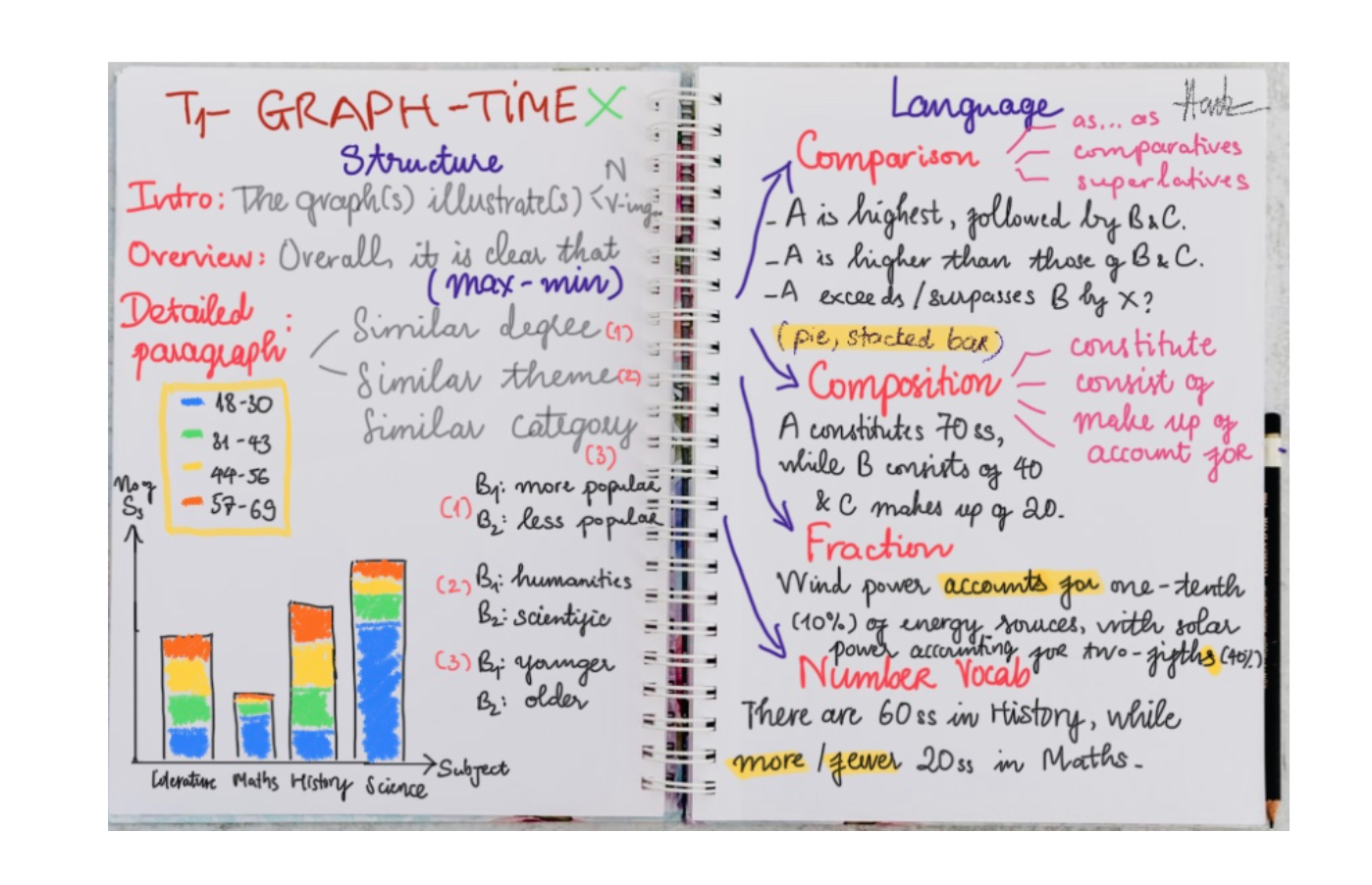
Paragraph 1: Introduction: chỉ cần paraphrase lại đề bài.
Paragraph 2: Overview: nhận xét chung chung key features.
Paragraph 3-4-5: Body 1-2-3: chia ý tưởng ra 2 mảng chính để có Body 1 & Body 2 ( nếu thật sự cần thiết, có thể viết thêm Body 3 ).
Explanation & example ( Giải thích & ví dụ minh hoạ ):
I. General Overview ( nhìn tổng quan )
II. Visual aids ( hình ảnh minh hoạ )
III. Specific content ( nội dung cụ thể )
Criteria 1: Task Achievement
( trả lời đúng yêu cầu đề bài )
Introduction: paraphrase lại đề bài
The graph + illustrates
+ ( A = Uncountable Noun ) → how much = the amount of A
+ ( A = Countable Noun ) → how many = the number of A = the quantity ( thing ) of A
+ ( A = % ) → the percentage / proportion / rate / share of A
Overview:miêu tả xu hướng chung chung & chọn lọc key features của đề bài.
Overall, it is clear that + SVO ….
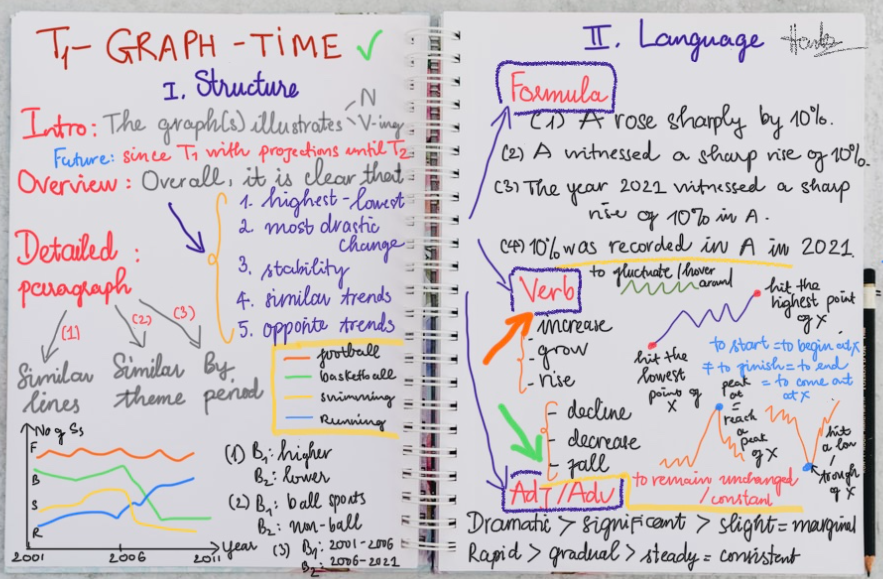
( sử dụng checklist dưới đây, dựa vào đó để viết:
The highest - lowest ( item luôn cao hay thấp nhất cả giai đoạn )
The most drastic change ( item có mức độ thay đổi lớn nhất )
Stability ( item chạy ổn định cả giai đoạn )
Similar trends ( các items đi cùng xu hướng )
Opposite trends ( các items đi ngược xu hướng )
Body parts : luôn cố gắng chia theo 2 mảng số liệu ( nếu k thì Body 3 )
Approach 1:
SIMILAR LINE
( chia theo xu hướng hình )
Approach 2:
SIMILAR THEME
( chia theo chủ đề )
Approach 3:
BY PERIOD
( chia theo giai đoạn )
Body 1: higher figure
Body 2: lower data
Body 1: Asian countries
Body 2: European countries
Body 1: Starting - turning point of time
Body 2: Turning - ending point of time
5-minute Plan
Intro: paraphrase
Overview:
1. The highest - lowest ( item luôn cao hay thấp nhất cả giai đoạn ):
2. The most drastic change ( item có mức độ thay đổi lớn nhất ):
3. Stability ( item chạy ổn định cả giai đoạn ):
4. Similar trends ( các items đi cùng xu hướng ):
5. Opposite trends ( các items đi ngược xu hướng ):
Body parts:
Body 1: ↓
Body 2: ↑
Sample models - band 9
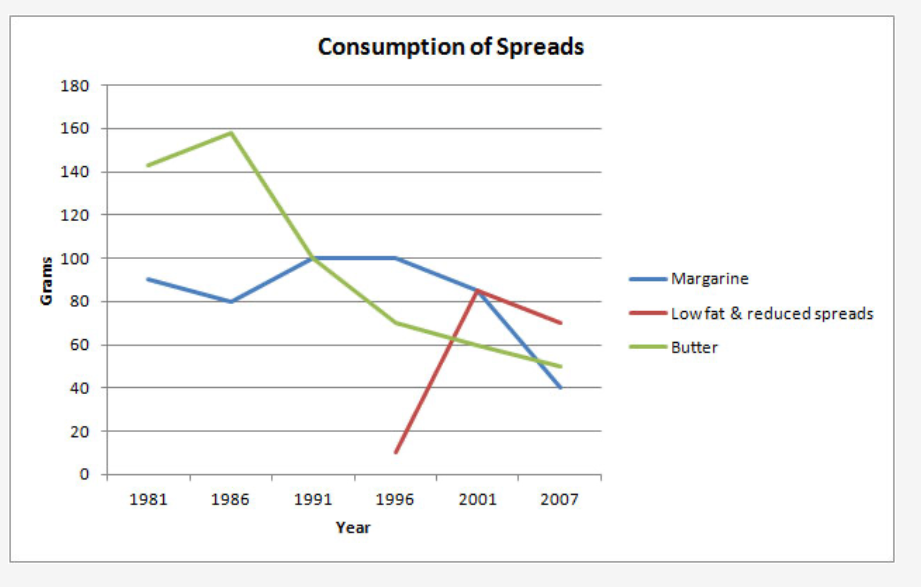
Question: The graph shows the consumption of three spreads from 1981 to 2007. Summarise the information by selecting and reporting the main features, and make comparisons where relevant.
Introduction: The line graph illustratesthe amount of three kinds of spreads (margarine, low fat and reduced spreads, and butter) which were consumedover 26 years from 1981 to 2007. Units are measured in grams.
Overview:Overall, the consumption of margarine and butter decreased over the period given, while for low fat and reduced spreads, it rose. At the start of the period, butter was the most popular spread, which was replaced by margarine from 1991 to 2001, and following that low fat and reduced spreads became the most widely used spread in the final years.
Body:With regards to the amount of butter used, it began at around 140 grams and then peaked at 160 grams in 1986 before falling dramatically to about 50 grams in the last year. Likewise, approximately 90 grams of margarine was eaten in the first year after which the figure fluctuated slightly and dropped to a low of 40 grams in 2007.
On the other hand, the consumption of low fats and reduced spreads only started in 1996 at about 10 grams. This figure, which reached a high of just over 80 grams 5 years later, fell slightly in the final years to approximately 70 grams in 2007.
( Giới thiệu: Biểu đồ đường dẫn minh họasố lượng của ba loại chất phết lên bánh (bơ thực vật, loại phết ít và giảm chất béo, và bơ) được tiêu thụtrong 26 năm từ năm 1981 đến năm 2007. Đơn vị được đo bằng gram.
Tổng quan:Nhìn chung, tiêu thụ bơ thực vật và bơ đã giảm trong khoảng thời gian này, trong khi tiêu thụ của loại phết ít và giảm chất béo, đã tăng lên. Vào đầu giai đoạn này, bơ là loại chất phết lên bánh phổ biến nhất, nhưng bị thay thế bởi bơ thực vật từ năm 1991 đến năm 2001, và sau đó loại phết ít và giảm chất béo trở thành loại chất phết lên bánh được sử dụng rộng rãi nhất trong những năm cuối.
Thân bài:Về lượng bơ được sử dụng, nó bắt đầu khoảng 140 gram và sau đó đạt đỉnh 160 gram vào năm 1986 trước khi giảm mạnh đến khoảng 50 gram trong năm ngoái. Tương tự như vậy, khoảng 90 gram bơ thực vật đã được ăn trong năm đầu tiên, sau đó con số thay đổi một chút và giảm xuống mức thấp nhất là 40 gram vào năm 2007.
Mặt khác, việc tiêu thụ loại phết ít và giảm chất béo chỉ bắt đầu vào năm 1996 với khoảng 10 gram. Con số này, đạt đỉnh chỉ hơn 80 gram 5 năm sau đó, giảm nhẹ trong những năm cuối cùng xuống còn khoảng 70 gram vào năm 2007. )
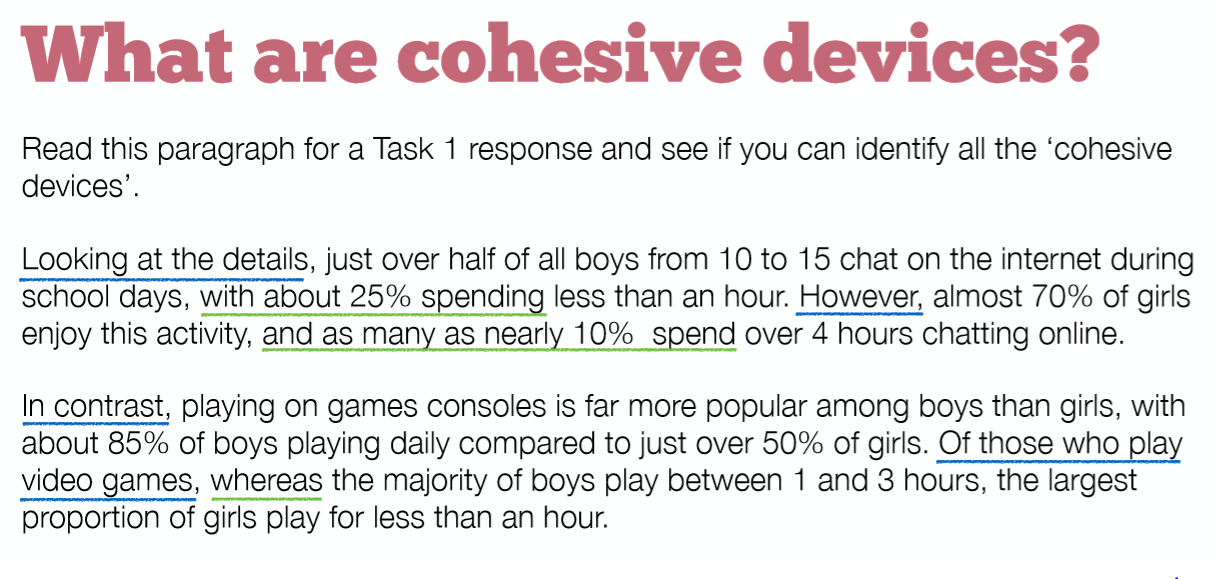
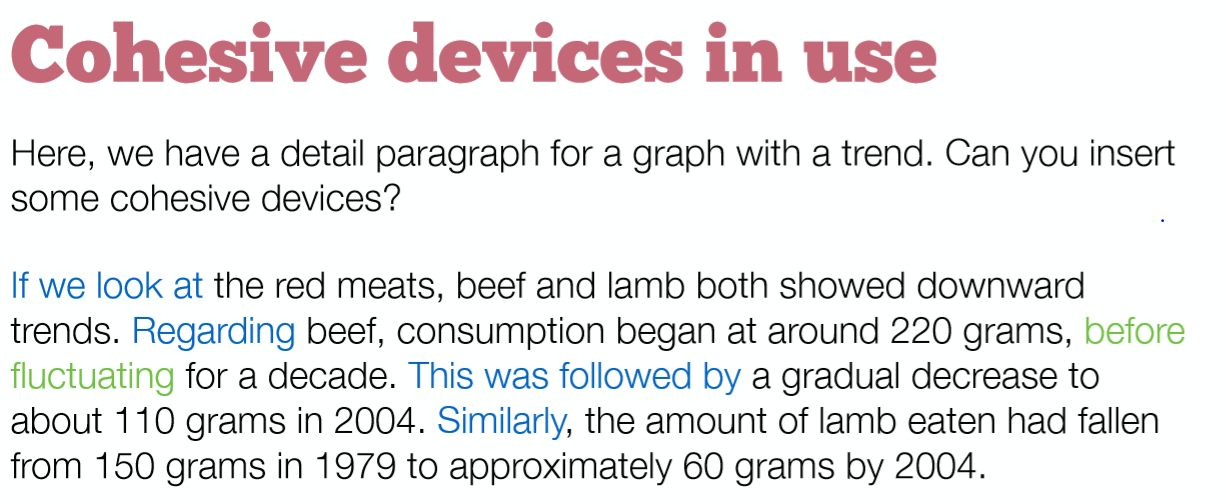
Criteria 2: Coherence & Cohesion
( liên kết mạch lạc )
( Từ nối liên kết các câu tách biệt nhau )
Overview / detail
( khi nói đến)
Link stages
( Kết nối các bước )
Suggest contrast
( Gợi ý các ý ngược nhau )
Add another point
(Thêm ý mới )
Overall,
( Nhìn tổng quan, )
At this point,
( Tại thời điểm này, )
Following this,
After that,
Next,
Subsequently,
Then,
( Sau đó thì, )
However,
In contrast,
On the other hand,
( Tuy nhiên )
In addition,
Additionally,
Moreover,
( Thêm vào đó, )
With regard to/ Regarding / Concerning…
( Khi mà nói đến, )
( Từ nối liên kết các thành tố bên trong 1 câu )
Link stages
( Kết nối các bước )
Suggest contrast
( Gợi ý các ý ngược nhau )
Add another point
( Thêm ý mới )
_ …,and this was followed by….
( theo sau đó thì )
=> Example:
She finished her homework, and this was followed by watching TV.
Translation:
Cô ấy làm xong bài tập về nhà, và sau đó là xem TV.
_ After/before being + verb-ed, ….
( Sau khi/ trước khi ….)
=>Example:
After being told the news, she started crying.
Translation:
Sau khi được thông báo tin tức, cô ấy bắt đầu khóc.
_ …..,whereas
( trong khi )
=> Example:
He loves spicy food, whereas his brother prefers sweet dishes.
Translation:
Anh ấy thích đồ ăn cay, trong khi em trai anh ấy lại thích đồ ngọt.
_ Despite…., ….
( mặc dù )
=> Example:
Despite the rain, they went for a walk.
Translation:
Mặc dù trời mưa, họ vẫn đi dạo.
_ …..,with + subject + verb-ing
( với điều gì được làm nên )
=> Example:
She sat by the window, with the sun shining on her face.
Translation:
Cô ấy ngồi bên cửa sổ, với ánh nắng chiếu vào mặt.
_ SVO1, while SVO2
( trong khi )
=> Example:
She was reading a book, while he was watching TV.
Translation:
Cô ấy đang đọc sách, trong khi anh ấy đang xem TV.
Example: The stock market plunged by 20% in a single day.
Translation: Thị trường chứng khoán đã giảm sâu 20% chỉ trong một ngày.
Others ( từ vựng khác )
_ fluctuate around…( dao động ) = hover around … ( dao động )
Example: The temperature fluctuated / hovered around 20°C last week.
Translation: Nhiệt độ dao động quanh mức 20°C vào tuần trước.
_ to peak at… ( lên đỉnh )
Example: The company's profits peaked at $1 million in December.
Translation: Lợi nhuận của công ty đạt đỉnh ở mức 1 triệu đô la vào tháng 12.
_ remain + adj ( unchanged, stable, constant ) = to level off ( giữ nguyên )
Example: After a period of growth, the stock price remained stable / unchanged / constant at $50 per share = After a period of growth, the stock price levelled off at $50 per share
Translation: Sau một giai đoạn tăng trưởng, giá cổ phiếu giữ nguyên ở mức 50 đô la một cổ phiếu.
_ To reach/ hit the + highest/ lowest point of … ( chạm vào điểm cao nhất / thấp nhất )
Example: The unemployment rate hit its lowest point of 3% in March.
Translation: Tỷ lệ thất nghiệp chạm vào điểm thấp nhất là 3% vào tháng Ba.
Nouns
↑ ( tăng )
↓ ( giảm )
An increase / A rise
English: The number of students in the class saw an increase / a rise from 20 to 25 this year.
Vietnamese: Số lượng học sinh trong lớp đã tăng từ 20 lên 25 trong năm nay.
A growth
English: There has been a steady growth in the company’s profits over the last five years.
Vietnamese: Đã có sự tăng trưởng ổn định trong lợi nhuận của công ty trong suốt năm năm qua.
An improvement
English: The test scores showed an improvement, with the average rising from 70% to 80%.
Vietnamese: Điểm thi cho thấy sự cải thiện, với điểm trung bình tăng từ 70% lên 80%.
=> Cách dùng của mỗi cụm sẽ hơi khác chút tùy vào văn cảnh, nhưng trong một vài trường hợp thì có thể là paraphrases của nhau
A drop
A fall
A decline
A decrease
Example: The company saw a fall / drop / decrease / decline in its profits last quarter.
Translation: Công ty đã chứng kiến lợi nhuận giảm trong quý vừa qua.
Others
To experience / witness a fluctuation of X (Trải nghiệm một sự dao động trong khoảng X )
Example: "The company's stock price witnessed / experienced a fluctuation of $5 over the week."
Translation: "Giá cổ phiếu của công ty đã trải nghiệm một sự dao động trong khoảng 5 đô la trong suốt tuần."
To reach a peak of Y: lên đỉnh tại điểm Y
Example: "The temperature reached a peak of 35°C yesterday."
Translation: "Nhiệt độ đã lên đỉnh tại điểm 35°C vào ngày hôm qua."
To hit a trough / low (n) of Z: chạm đáy tại điểm Z
Example: "The unemployment rate hit a low of 3% last year."
Translation: "Tỷ lệ thất nghiệp đã chạm đáy tại điểm 3% vào năm ngoái."
To experience / witness / see + a rise/fall/drop of U
Example: "The company saw a rise of 20% in sales this quarter."
Translation: "Công ty đã chứng kiến một sự gia tăng 20% trong doanh số bán hàng của quý này."
Adjective & adverbs – degree of change:
Volume
Big
dramatic
Dramatically
Considerably
Sharp
_ Example: "The increase in sales was dramatic after the new advertising campaign."
Vietnamese: "Sự tăng doanh số là rất đáng kể sau khi chiến dịch quảng cáo mới bắt đầu."
_ Example: "The temperature dropped dramatically overnight."
Vietnamese: "Nhiệt độ giảm mạnh qua đêm."
Medium
significant
Significantly
Moderate
_ Example: "There was a significant rise in the number of visitors last month."
Vietnamese: "Số lượng khách tham quan tăng đáng kể trong tháng trước."
_ Example: "The company's profits increased significantly this year."
Vietnamese: "Lợi nhuận của công ty tăng đáng kể trong năm nay."
Small
slight
Slightly
Marginal
Minimal
Tiny
_ Example: "There was a slight decrease in the number of errors in the report."
Vietnamese: "Số lỗi trong báo cáo giảm nhẹ."
_ Example: "The temperature has increased slightly over the past week."
Vietnamese: "Nhiệt độ đã tăng nhẹ trong tuần qua."
Speed
Fast
rapid
rapidly
_ Example: "The city's population growth was rapid last year."
Vietnamese: "Sự tăng trưởng dân số của thành phố nhanh chóng trong năm qua."
_ Example: "Technology is evolving rapidly these days."
Vietnamese: "Công nghệ đang phát triển nhanh chóng hiện nay."
Slow
gradual
gradually
_ Example: "There was a gradual improvement in the economy over the year."
Vietnamese: "Kinh tế đã cải thiện dần dần trong suốt năm qua."
_ Example: "The team gradually became more efficient with practice."
Vietnamese: "Đội đã dần trở nên hiệu quả hơn nhờ luyện tập."
Consistent
steady
steadily
_ Example: "The company has shown steady growth in revenue."
Vietnamese: "Công ty đã thể hiện sự tăng trưởng ổn định về doanh thu."
_ Example: "The population of the town has been growing steadily."
Vietnamese: "Dân số của thị trấn đã tăng trưởng đều đặn."
Surprising
striking
strikingly
_ Example: "The data showed a striking difference between the two groups."
Vietnamese: "Dữ liệu cho thấy sự khác biệt rõ rệt giữa hai nhóm."
_ Example: "The results were strikingly different from the previous study." Vietnamese: "Kết quả khác biệt rõ rệt so với nghiên cứu trước đó."
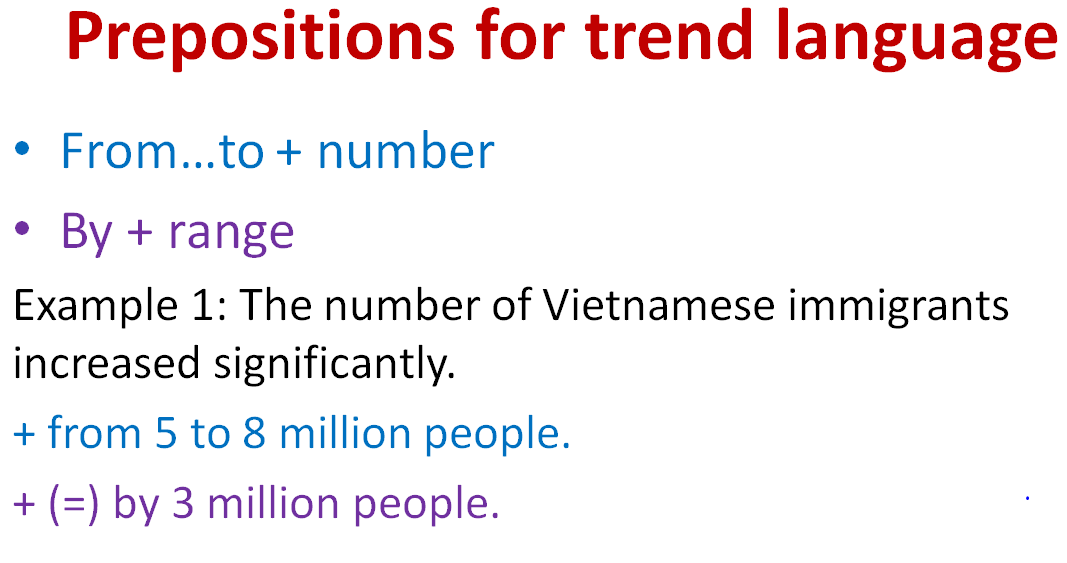
* Of ( vs Noun ):
Example: The number of Vietnamese immigrants increased (v) significantly by 3 million.
= The number of Vietnamese immigrants experienced a significant increase (n) of 3 million.
(Số lượng người nhập cư từ Việt Nam tăng (v) đáng kể lên 3 triệu.
= Số lượng người nhập cư từ Việt Nam trải qua một sự thay đổi đáng kể đến 3 triệu.)
REFERENCING
The former / the latter (vế (cái) trước / vế (cái) sau )
Another way we can avoid repetition and improve cohesion is with the above expressions “former” and “latter”.
England and Denmark both had approval ratings of 45% in 1990, but whereas the former fell to just 20% in 1995, the latter surged to 80%.
(Anh và Đan Mạch đều có tỷ lệ phê duyệt 45% vào năm 1990, nhưng trong khi tỷ lệ đầu giảm xuống còn 20% vào năm 1995, tỷ lệ sau tăng lên 80%.)
Correspondingly / Respectively (tương ứng)
Another very handy way of avoiding repetition and saving time when presenting multiple points of information is to use the word “respectively”, which essentially means “according to the previous order”.
In 1995, the approval ratings of England and Denmark were 20% and 80% respectively.
(Năm 1995, tỷ lệ phê duyệt của Anh và Đan Mạch là 20% và 80% tương ứng.)
TREND LANGUAGE
Commence / start / begin + at X
(bắt đầu tại X)
Finish / end / come out + at X
(kết thúc tại X)
To fluctuate = to hover around X = to saw a fluctuation (diễn tả sự dao động)
To peak at / reach a peak of X
(chạm đỉnh - điểm cực đại)
To hit / reach the highest point of (điểm cao nhất)
To hit / reach a low / trough of(chạm đáy - điểm cực tiểu)
To hit / reach the lowest point of
(điểm thấp nhất)
To level off = to remain / stay + unchanged / constant / intact / untouched
(diễn tả sự bằng phẳng)
Age group
E.g: 18- to 30 year-old (adj) students
……………18 to 30 years old = years of age………
……………Students aged 18 to 30……..
……………Students in the 18 to 30 age bracket…….
Paraphrasing units of measurement
Example: In 2012, 64,000 people visited Sweden, while 25,000 visited Norway.
In 2012, 64.000 people visited Sweden, while 25,000
Paraphrasing:
Way 1: In 2012, 64,000 people visited Sweden, while + the figure for + Norway was 25,000.
Way 2: …………………..+ the data for +………………
Way 3: ………………………+ + 25,000 was the figure / data for Norway.
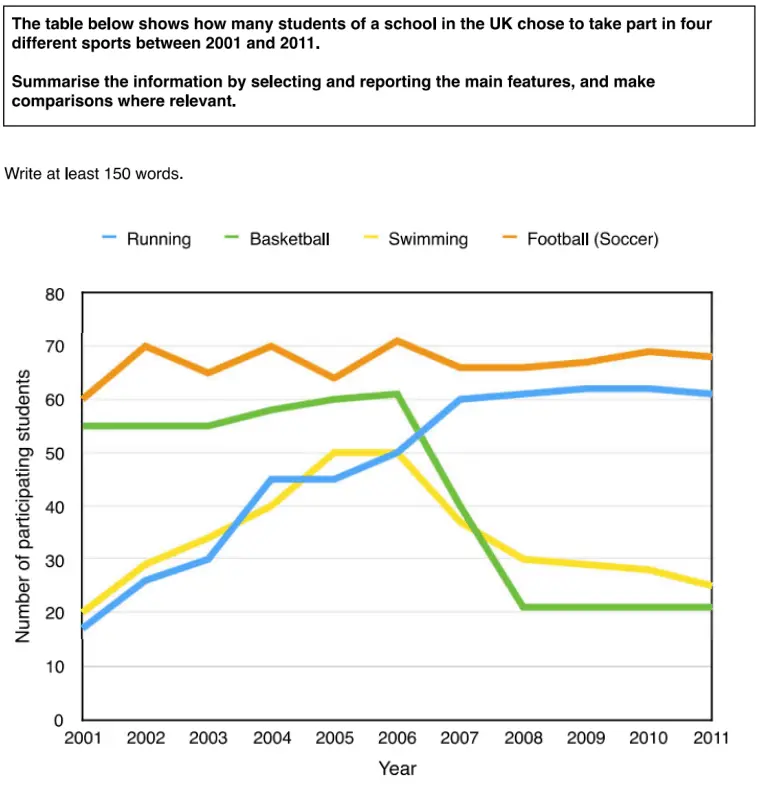
After 2006, the number of basketball students plummeted to just 20.
Between 2006 and 2007, the number of basketball students plummeted to just 20.
By 2008, the number of basketball students had plummeted to just 20.
In a two-year period from 2006 to 2008, the number of basketball students plummeted to just 20.
Pre-2006, basketball numbers ranged from 56 to 61, but post-2006, the number of basketball students plummeted to just 20.