Self-study tips: paraphrases in Reading with AI
This article provides a detailed guide on Paraphrasing skills in IELTS Reading, helping you identify information quickly and achieve higher scores. Learn the types of Paraphrasing and how to apply them with real examples from Cambridge IELTS tests.
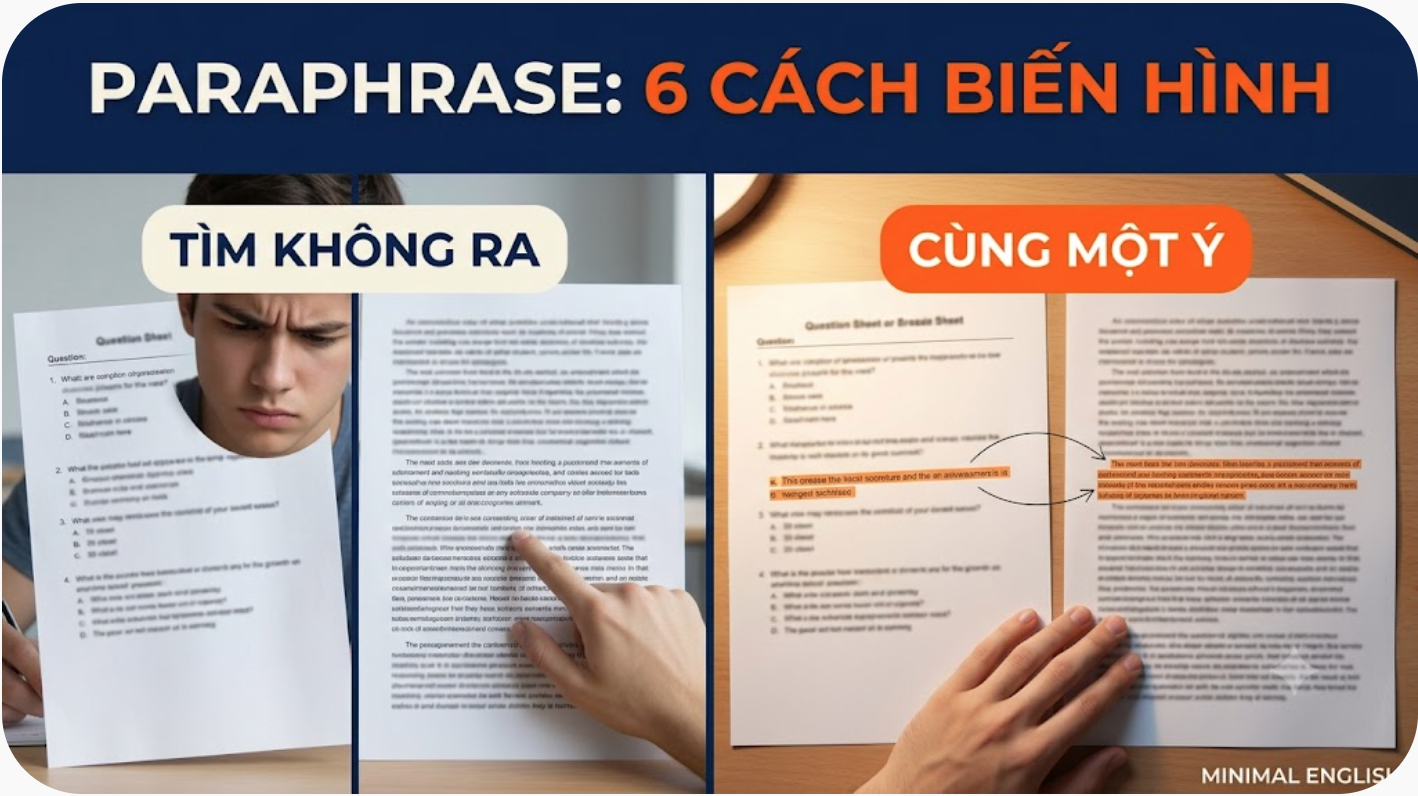
Ever find yourself reading IELTS Reading questions and not seeing the information in the passage? Don't worry, the answer might be there, just written differently!
That's why you need Paraphrasing – a crucial skill to identify information faster without reading every word 🚀

📌 What is Paraphrasing in IELTS Reading?
It's when the same meaning is expressed in different ways. A sentence can be transformed by:
1️⃣ Synonym substitutio
2️⃣ Antonym substitutio
3️⃣ Word form change
4️⃣ Sentence structure change
5️⃣ Creativit
6️⃣ Dummy subjects (It, There, etc.)
Let's explore each type and how to apply them in IELTS Reading
📌 1. Paraphrasing with Synonyms
💡 Example from Cambridge IELTS 17 – "The Secret of Persuasion"
🔹 Passage: "Individuals are more likely to agree when exposed to the reciprocity principle."
🔹 Question: "People tend to comply if they feel obligated to return a favour."
✅ Explanation:
- Individuals = People
- More likely = Tend to
- To agree = Comply
- Reciprocity principle = To return a favour
✨Lesson: No need to find the exact sentence in the passage, just look for synonyms!
📌 2. Paraphrasing with Antonyms
💡 Example from Cambridge IELTS 17 – "The Benefits of Bilingualism"
🔹 Passage: "Early researchers believed that bilingualism was harmful to children."
🔹 Question: "Some scientists in the past argued that learning two languages was beneficial for children."
❌ Wrong! Because "harmful" means damaging, but the question uses "beneficial" which means helpful.
✨ Lesson: If you see information reversed with antonyms, the answer might be FALSE in True/False/Not Given!
📌 3. Paraphrasing with Word Form Changes
💡 Example from Cambridge IELTS 16 – "The Psychology of Music"
🔹 Passage: "Listening to music enhances cognitive performance."
🔹 Question: "Music has an enhancing effect on cognitive abilities."
✅ Explanation:
- Enhances (verb) → Enhancing (adjective)
- Performance (noun) → Abilities (noun)
✨ Lesson: If you can't find the exact word, think about other word forms (verb → noun, noun → adjective).
📌 4. Paraphrasing with Sentence Structure Changes
💡 Example from Cambridge IELTS 15 – "Eco-tourism"
🔹 Passage: "Governments must implement strict regulations to protect endangered species."
🔹 Question: "Strict environmental policies are required to safeguard animals facing extinction."
✅ Explanation:
- Governments must implement = Policies are required
- Protect = Safeguard
- Endangered species = Animals facing extinction
✨ Lesson: If you can't find the exact phrase, try changing the sentence order when reading.
📌 5. Paraphrasing with Creativity
💡 Example from Cambridge IELTS 14 – "The Future of Work"
🔹 Passage: "Many companies are adopting a hybrid work model due to technological advancements."
🔹 Question: "Modern businesses are integrating flexible work arrangements as a result of digital progress."
✅ Explanation:
- Hybrid work model = Flexible work arrangements
- Technological advancements = Digital progress
✨ Lesson: Sometimes, the author uses a completely different expression but with the same meaning.
📌 6. Paraphrasing with Dummy Subjects: It, There
💡 Example from Cambridge IELTS 18 – "Space Exploration"
🔹 Passage: "Scientists argue that sending humans to Mars is an inevitable next step."
🔹 Question: "It is widely believed that human exploration of Mars is unavoidable."
✅ Explanation:
- Scientists argue = It is widely believed
- Inevitable = Unavoidable
✨ Lesson: Don't panic when you see "It is believed", "There is evidence that…" – they can replace a specific subject in the passage.
📌 In summary, how to apply Paraphrasing in IELTS Reading?
🚀 When doing IELTS Reading, remember:
✅ Can't find the exact words? Look for synonyms!
✅ Be careful with antonyms in True/False/Not Given questions!
✅ Pay attention to different word forms – verbs, nouns, adjectives!
✅ If you can't find the information, check if the sentence is rewritten in a different structure!
✅ Don't panic when you see "It is believed…" – it might just be a paraphrase of a viewpoint in the passage!
Have you tried this method? If not, try it today! 🚀 Simpler learning, better result!